The Rosetta Stone: Three Scripts, One Breakthrough
A royal decree in three scripts helped scholars recover the ability to read ancient Egyptian hieroglyphs.
The narrated story
Watch, then look closer.
Watch the Bronze & Lore video on YouTube. Playback opens on YouTube; no video player or tracking is loaded here.
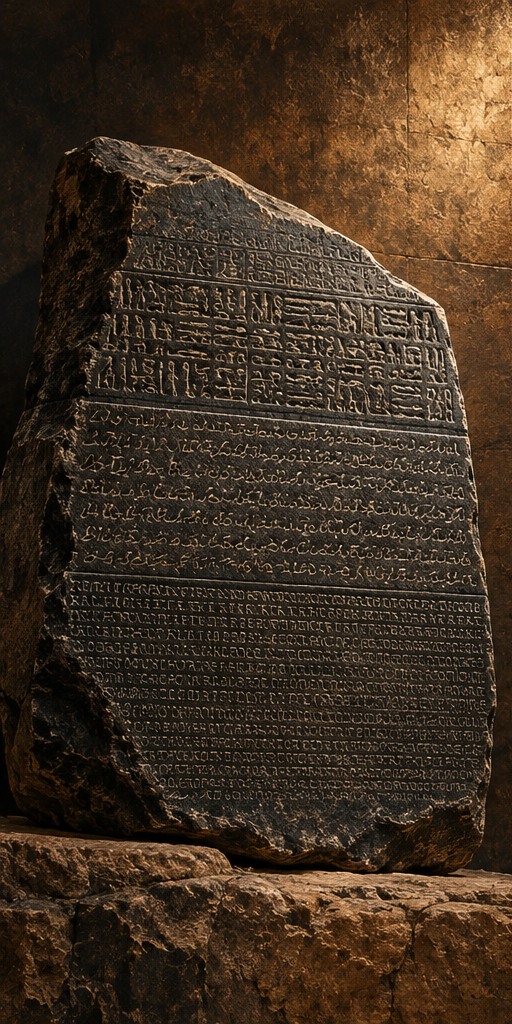
Watch on YouTube (opens in a new tab)Three bands of writing cover the broken face of the Rosetta Stone. Their importance lies in the relationship between them: each presents a version of the same decree, giving scholars a way to compare writing they understood with writing they were still learning to read.
Issued by a council of priests in 196 BCE, the decree honoured King Ptolemy V. It belongs to the politics and religion of Ptolemaic Egypt, where royal support for temples and priestly support for the king were closely connected. The inscription records that relationship in hieroglyphs, Demotic and Greek. These are three scripts representing two languages: Egyptian and Greek.
French soldiers found the stone in 1799 during work on a fort near Rashid, also known as Rosetta. After the French defeat in Egypt, it passed into British possession in 1801 and entered the British Museum in 1802.
Decipherment took years of comparison. Thomas Young demonstrated that some hieroglyphs recorded sounds in the royal name Ptolemy. Jean-François Champollion developed the broader understanding that hieroglyphs could record the Egyptian language. His September 1822 letter became a landmark in that work.
The stone was an essential clue within a much larger investigation. Champollion also studied numerous other inscriptions and drew on his knowledge of Coptic. Understanding emerged through comparison across texts—a reminder that even a famous breakthrough rests on patient work with many pieces of evidence.
The reading behind the story
Sources & further reading
- British Museum: The Rosetta Stone (Google Arts & Culture) (opens in a new tab)
- Musée Champollion: Ex-libris — decipherment and the Rosetta Stone (opens in a new tab)
- Musée du Louvre: Champollion, la voie des hiéroglyphes (opens in a new tab)
Sources checked .

The past rewards a closer look.
Discover our editorial approach.